 |
JK-HairCoat |
 |
|
 |
|||
 |
|||


 Before Application (Important Preparation)
✔ Hair must be pre-washed and clean
✔ Remove oil, silicone residue, dust, gum-like buildup, or contaminants
✔ Hair must be combed and aligned so that all the strands are parallel in the same direction.
-
Before treatment, the hair must be thoroughly combed and properly aligned.
-
Tangled hair prevents uniform distribution of JK-HairCoat and may cause severe tangling, matting,
and hair loss during drying and subsequent processing.
-
Mixed short hairs are a major cause of tangling and should be removed before treatment.
 JK-HairCoat bonds to the hair through ionic interaction.
 Oil, silicone, conditioner residue, and other contaminants will interfere with ionic bonding and reduce the effectiveness of the treatment.
Recommended Quantity (Reference) When Using 3 ml or 5 ml of JK-HairCoat.
• 5 or more pcs of wigs (100–200 g per pc)
• 5 or 10 pcs of hair extensions / wefts (approx. 100 g per pc) in total, the amount of hair per treatment may be up to 1 kg.
(For larger industrial volumes, see A-IQ – Reference Only)
 |
**JK7882-SEV and JK7885-RST have the same application instructions when used individually.**However, if you wish to use **both formulations on the same hair product (such as a wig, a toupee, a hair extension, a bundle of bulk hair, a weft, a hair topper, or a closure), a different application procedure is required.**For instructions on using both formulations together, please visit: https://wigschool.com/7885.htm |

|
|||||||||||||||||||||||||||||||||||||||||||||
 |
STEP 1 — Prepare the Solution |
||||||||||||||||||||||||||||||||||||||||||||
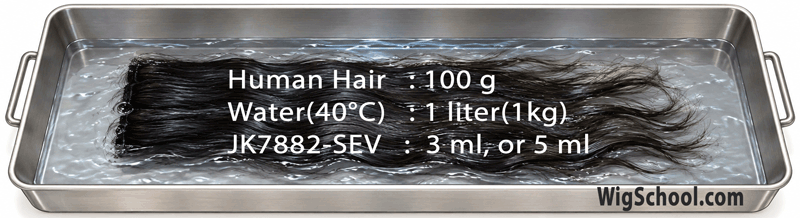
◆ Preparing a 0.3% JK-HairCoat Solution
The following quantities are provided as general guidelines when using 3–5 mL of JK-HairCoat in the recommended
The total hair weight per treatment may be up to approximately 1 kg, depending on the hair type, treatment method, |
|||||||||||||||||||||||||||||||||||||||||||||
 |
STEP 2 — Apply JK-HairCoat to the Hair (3 methods : |
||||||||||||||||||||||||||||||||||||||||||||
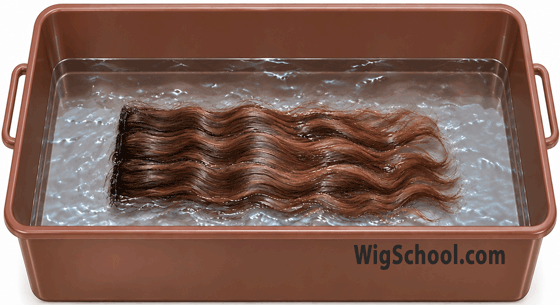
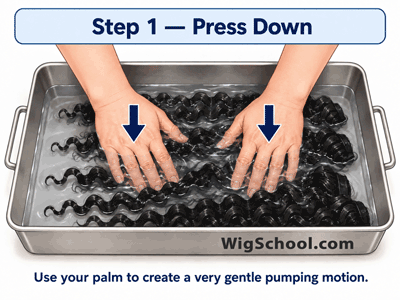
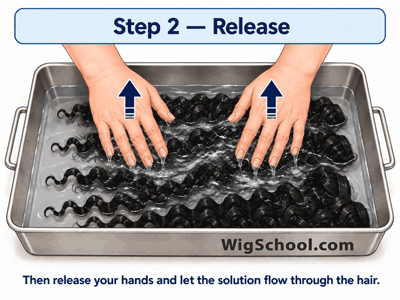
■ Choose one of the following three application methods, depending on the type and condition of the hair being treated.
|
|||||||||||||||||||||||||||||||||||||||||||||




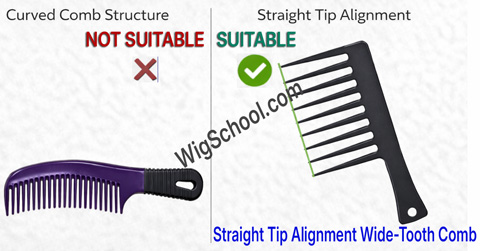
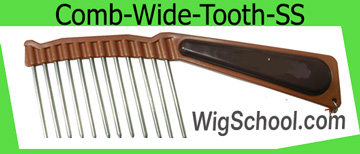
PRO TIP — Immersion Time■ Longer immersion times are generally acceptable. The important factor is ensuring that all hair strands are evenly and thoroughly wetted with the JK-HairCoat solution. For Straight or Non-Curly HairFor raw hair purchased in bundles or finished hair extensions without curls or waves, gently comb the hair while it is immersed in the JK-HairCoat solution. This helps distribute the solution evenly throughout the hair, separate overlapping strands, and keep the hair strands aligned in the same direction without crossing or tangling. Before removing the hair from the solution, gently squeeze out the excess liquid. DO NOT — Use Curved Combs.Please use wide tooth combs with straight tip alignment just like a comb, "Comb-Wide-Tooth-SS" and "CW211-WH" below. |
||
 |
 |
|
 |
||
■ Combing must be done ONLY while the hair is immersed in the solution
■ Combing outside the solution may cause pulling and mechanical stress,
as the hair fibers are not lubricated and may be interlocked.
The solution acts as a lubricant, reducing friction and helping smooth alignment.
■ Over-combing may cause excessive mechanical stress,
leading to deformation of the hair structure.
This may result in uneven fiber thickness and surface irregularity,
preventing the hair from achieving a smooth, silky, and vivid finish.
■ Immerging time does not significantly affect the result once ionic bonding is complete.
Ionic bonding occurs rapidly within the first 7–10 seconds, and extending the immersion time (e.g., 1 minute, 10 minutes, or 1 hour) does not increase the coating effect much.
■ When using the spraying method, a higher concentration of JK-HairCoat is generally required than for the Soaking + Combing or Dipping + Squeezing methods.
■ For example, mix 5–10 g (approximately 5–10 mL) of JK-HairCoat with 1,000 g of water to prepare a 0.5–1.0% solution.
Unlike the soaking method, this method does not require immersing the entire batch of hair in the solution at once.Instead, divide the hair into manageable bundles, each small enough to be held firmly in one hand.Dip one bundle into the JK-HairCoat solution for approximately 2–3 seconds, gently moving it to ensure even contact between the solution and individual hair strands.Remove the bundle from the solution and gently squeeze out the excess liquid.Repeat the same procedure with the remaining bundles, one after another, until the entire batch has been treated.
|
||
|
||
STEP 1 — Prepare the Solution |
||
For treating 1 Kg, 2 Kg, up to 5 Kgs of hair in the video 02 & 03, we mixed (used) as follows:1) Wate 40 ℃ after hair is put in): 5 Liters (5 Kgs) |
||
STEP 2 — Apply JK-HairCoat to the Hair |
||
Application Procedure — One Hair Bundle at a Time |
||
1. Hold the Hair Bundle Hold the upper end of a manageable bundle of hair very firmly with your left hand to keep it securely in place. Each bundle should be small enough to be held firmly in one hand. 2. Dip the Hair Dip the hair bundle into the JK-HairCoat solution for approximately 2–3 seconds. 3. Squeeze Firmly While Lifting As you lift the bundle out of the solution, use your right hand to squeeze the hair firmly and slide downward along its length. This action helps push the JK-HairCoat solution through and between the hair strands while removing excess liquid. 4. Repeat 2–3 Times Dip the same bundle back into the solution and repeat the firm downward squeezing motion as you lift it out. Complete 2–3 dipping-and-squeezing cycles on the first side within approximately 10 seconds. The cationic conditioning components in JK-HairCoat are rapidly attracted to negatively charged sites on the hair surface through electrostatic attraction. Based on our practical experience, approximately 10 seconds of treatment can be sufficient for effective adsorption under suitable conditions. 5. Turn the Hair Bundle Over Turn the bundle over to expose the other side to the solution. 6. Repeat Another 2–3 Times Repeat the dipping-and-squeezing procedure 2–3 more times, ensuring that the JK-HairCoat solution reaches the hair evenly. 7. Set the Treated Bundle Aside Set the treated bundle aside and proceed to the next bundle. 8. Continue Until All Bundles Are Treated Repeat the same procedure, one bundle at a time, until the entire batch of hair has been treated. Total: 2–3 cycles on the first side + 2–3 cycles after turning the bundle over = 4–6 dipping-and-squeezing cycles per bundle. |
||
| Treatment
by Dipping & Squeezing Method for 0.5 or some Kgs, 100 gr pc x 10 pcs (10 times) of human hair at a time, treating each pc (bundle) for 7 ~ 10 seonds |
||
| Video
02 (filmed in winter) - Dipping & Squeezing (small q'ty) |
Video
03(filmed in winter) - Dipping & Squeezing (small q'ty) |
|
 |
 |
|
 If you want more (thicker) coating effect (after hair has been dried), you treat the hair one more time witht the JK-haircoat solution. When
we would treat another 5 kgs of hair after the above 5 kgs of
hair, we add 15ml of JK7882-SEV to the solution used for the
1st 5 kgs. |
||

STEP 3 — SPIN-DRYING: REMOVAL OF EXCESS SOLUTION (Optional)
Note:
This step is for users with spin-drying equipment.
If unavailable, please skip this step and proceed directly to natural drying.
➤ Spin-Drying Procedure
➤ Gently squeeze out some of the excess JK-HairCoat solution from the hair.
➤ Place the hair evenly around the inner circumference of the spin-dryer drum, distributing its weight as uniformly as possible to prevent an unbalanced load.
➤ Use a suitable spin dryer or the spin-only function of a household washing machine.
➤ Select an appropriate spin-speed setting and run the machine until most of the excess solution has been removed.
✓ Check the Spin-Drying Results
✓ Target: Remove approximately 70–80% of the liquid from the hair before the final drying process.
✓ The hair should remain damp but should no longer drip liquid.
⚠ Important Precautions
⚠ Use only equipment suitable for the type and quantity of hair being processed.
⚠ Do not use a tumble-drying cycle during this step. Spin-drying and tumble-drying are different processes.
◆ Benefits of Spin-Drying
◆ Significantly reduces the final drying time.
◆ Helps remove excess JK-HairCoat solution and unwanted residues.
◆ Minimizes excessive residue accumulation between hair strands.
◆ Helps prevent an unpleasant sticky or oily finish.
■ Practical Example — 9-Minute Spin Cycle
■ With one of our older LG household washing machines, we have used a 9-minute spin-only cycle.
■ The appropriate spin speed and duration may vary depending on the machine, load size, and condition of the hair.

STEP 4 — DRYING : Natural Drying / Oven Drying

Feedback from Amsterdam:
Afterwards, I carefully remove the hair (from the solution) and let the excess water drip off.I gently pat it dry with a towel (without rubbing), then hang it up and let it air-dry.
I usually wait until the hair is almost completely dry before styling it.
When suitable, use a centrifugal spin dryer or the spin-only cycle of a household washing machine to remove approximately 70–80% of
the water before drying.
◆ Method A — Natural Air-Drying: Straight Hair
➤ Hang the Hair for Drying
➤ If a drying oven is unavailable, hang straight (non-curly) hair on a clothesline in a warm, well-ventilated area.
➤ Arrange the hair so that the strands hang freely without excessive twisting or tangling.
➤ Allow the Hair to Dry Completely
➤ Leave the hair hanging until completely dry.
■ Drying may take several hours or considerably longer, depending on the temperature, humidity, airflow, and amount of hair.
⚠ Protect the hair from dust, excessive humidity, strong wind, and direct sunlight.
◆ Alternative — Flat Air-Drying
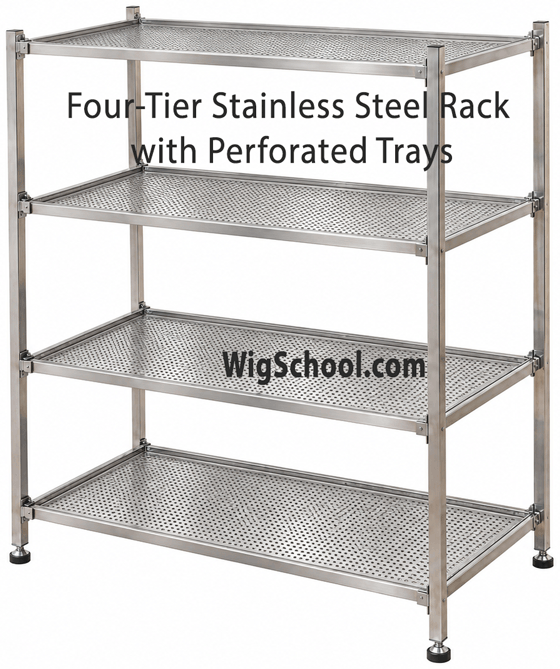
➤ Instead of hanging the hair, spread it thinly and evenly on a flat, perforated drying tray.
➤ Allow the hair to dry naturally under the same suitable environmental conditions.
✓ Ensure adequate airflow above and below the tray.
◆ Method B — Natural Air-Drying: Wavy or Curly Hair
⚠ Important — Do Not Hang Wet Curly Hair
⚠ Avoid hanging wavy or curly hair while it is wet.
■ The weight of wet hair, combined with gravity, may stretch the waves or curls and loosen their original pattern during drying.
➤ Arrange the Hair on a Drying Tray
➤ Place the damp hair on a flat, perforated drying tray.
➤ Spread and arrange the hair gently, preserving its original wave or curl pattern.
➤ Allow the hair to dry naturally without stretching, pulling, or hanging it.
✓ Check that the original wave or curl pattern is maintained throughout the drying process.
■ After spin-drying, the hair may be dried naturally in a well-ventilated area, in a warm room, or in a suitable drying oven or drying machine.
■ Choose the drying method according to the hair type, condition, and available equipment.
◆ Method C — Oven Drying (Heat Drying)
➤ Spread the Hair Evenly
➤ Remove the hair from the spin dryer.
➤ Spread the hair in a thin, even layer on a perforated drying tray, avoiding excessive overlapping.
➤ Arrange and Align the Hair Strands
➤ For straight hair, keep the strands—especially near the roots or upper portions—straight and properly aligned, without sharp bends, kinks, or unwanted waves.
➤ If necessary, gently align the strands using a damp towel.
⚠ For wavy or curly hair, preserve the original wave or curl pattern rather than straightening the strands.
➤ Place the Tray in the Drying Oven
➤ Carefully place the prepared tray inside a suitable drying oven or drying machine.
➤ Set the Temperature and Drying Time
➤ For suitable, heat-tolerant human hair, set the drying temperature to approximately 75–80°C.
➤ An initial drying time of approximately 2–3 hours may be used, depending on the amount of hair, the thickness of the hair layer, and the moisture remaining after spin-drying.
✓ Check the Final Dryness
✓ Make sure the hair is completely dry before considering the drying process finished.
⚠ Do not apply 75–80°C indiscriminately to heat-sensitive, severely damaged, or synthetic hair. Use a lower temperature suitable for the particular hair or fiber.
■ For more detailed instructions, please see: HEAT-DRYING METHOD (OVEN-DRYING METHOD) 
■ Recommended Perforated Drying Tray Specifications
■ The following specifications may be used for perforated drying trays intended for oven drying or flat air-drying.
■ Hole diameter: Approximately 5 mm.
■ Spacing between holes (edge to edge): Approximately 5 mm.
⚠ Avoid excessively large holes.
■ Wet hair may sag into large openings, potentially leaving marks or distorting the hair's original shape or curl pattern.
✓ Ensure Adequate Airflow
✓ Use a perforated tray with sufficient open area to allow air to circulate through and around the hair.
■ Adequate airflow promotes more uniform and efficient drying while helping preserve the hair's original shape and curl pattern.
■ Detailed tray specifications, including hole size and spacing, are available upon request.
⚠ Important Handling Notes — After Heat Drying
⚠ Avoid touching, pulling, rubbing, brushing, or combing the hair unnecessarily while it is still hot or warm immediately after oven drying.
➤ Allow the heated hair to cool completely before further handling or processing.
✓ Check that the hair has cooled sufficiently before combing, packaging, or performing additional treatments.
■ Excessive pulling, stretching, or friction while the hair is warm may adversely affect the final coating finish.
■ Additional Technical Notes
■ Hair Temperature and Water Temperature
■ When cold hair is immersed in warm water, the water temperature may decrease, particularly when processing large quantities of hair.
✓ Check and adjust the JK-HairCoat solution temperature when necessary.
■ Water Quality
■ JK-HairCoat is intended to be diluted with clean water, preferably water with low mineral content and minimal impurities.
■ Water pH
■ Slightly alkaline water, approximately pH 8, is generally acceptable for JK-HairCoat treatment.
■ For further technical guidance or assistance, please contact John Yim via WhatsApp or email.

JK7882-SEV / JK7885-RST |
|
**JK7882-SEV and JK7885-RST have the same application instructions when used individually.**However, if you wish to use **both formulations on the same hair product (such as a wig, a toupee, a hair extension, a bundle of bulk hair, a weft, a hair topper, or a closure), a different application procedure is required.**For instructions on using both formulations together, please visit: ttps://wigschool.com/7885.htm |
|
 |
|
Application Method for Large-Batch Hair Treatment
|
|
Application Method for Large-Batch Hair Treatment
|
|