|
||||||||||||||||
 |
||||||||||||||||
Hands-on Training for Making Lace Wigs, Lace Toppers, and Lace Frontals |
||||||||||||||||
|
||||||||||||||||
| What You Will Learn to Make: | ||||||||||||||||
 |
Full lace wigs made entirely with lace (or net), without any skin base. | |||||||||||||||
 |
Lace-front wigs using Swiss lace, French lace, German lace, or fine monofilament net | |||||||||||||||
 |
Lace frontals and mesh (lace) tops (closures) | |||||||||||||||
|
Other hairpieces and wigs for women and men, produced by hand-tying, without glue application or chemical processing after hair tying or knotting |
|||||||||||||||





 CLASS SIZE:
 Our classes are conducted one-on-one. For company or family groups, up to three trainees may attend. All sessions are taught by two or three instructors with over 35 years of experience in hand-tied products.

1. Train you to hand-implant (hand-tie) hair onto lace front wig caps made of French lace, Swiss lace, monofilament lace, and other materials. Training includes proper hair direction, distribution, density control, and styling considerations based on base material, hair type, curl pattern, and length.
2. Provide an overview of lace front wig cap construction. Cap-making practice is not included, as this process can be handled by professional sewing specialists.
3. Provide detailed information on necessary materials, designs, and construction methods.
We can also supply the required materials, tools, and pre-made caps (bases/foundations).
|
||
| The toupee manufacturing class includes base-making, which involves liquid chemical work and heat treatment (drying) when making the base and bonding knotted hair to PU skin parts of a wig or closure. |
||
| Unlike the toupee manufacturing class, the lace wig manufacturing class does NOT include liquid chemicals, glue work, or oven drying in the base construction process. |
||
| Foundations (Wig Caps / Bases): The foundations (wig caps or bases) used in our LACE WIG training are made without liquid chemicals, glue work, or oven drying. The hair is knotted directly onto the lace or base material. |
||
| Toupees (Men’s Hairpieces) Most men’s hairpieces (toupees) are made using skin materials and/or liquid adhesives combined with very fine, firm meshes such as Fine Mono nett, French Lace, German Lace, and Swiss net, HD Laces, Ultra-sonice Welded nets. |
||
| The manufacturing process involves adhesive bonding during base construction and securing the knotted or injected hair, followed by heat curing for several hours. |
||
Hand-Tied Lace Wigs (For Women) Most hand-tied lace wigs for women are constructed entirely on flexible lace materials. No adhesive bonding is required in the base construction, and therefore no heat-drying process is involved. |
||
Lace Wigs Designed for Glue Attachment Lace wigs intended for glue attachment typically use fine lace materials (such as Swiss mono net, HD laces) The remaining sections may use more economical or stretchable (or non-stretchable) mesh materials. These are commonly referred to as “lace front wigs.” |
||
 Difference Between
Lace Wig Manufacturing Class and Toupee Manufacturing Class
Difference Between
Lace Wig Manufacturing Class and Toupee Manufacturing Class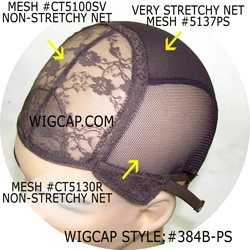
 Materials Supply
We supply Swiss net starting from as little as 1 yard.
Other lace or mesh materials are available with a minimum order quantity of 100 yards (40-inch width).
We also supply lace wig caps (bases/foundations) for hair implantation.
These wig caps can be produced by professional sewing specialists, and the necessary netting materials
(meshes, bands, ribbons) are widely available in most countries.
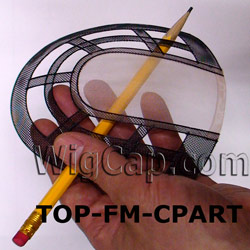
Mesh Top (Top Cap) made with Ultra-sonic Welded Net Cap(head-shaped)
Used for:
-
Adding more hair volume
-
Increasing hair length
-
Enhancing styling flexibility
Various hairstyles can be created.
We supply top caps with a minimum order quantity of 10 pieces per style, size, and color.
Available in black and skin (flesh) color.
Our Lace Wig-Making School teaches all standard hand-tie (hand-knotting) techniques, These specialized methods require adhesive bonding, glue coating, and extended heat curing. |
||
  |
||
  |
||
 |
||


1 Yard Supply Policy – Explanation
Why We Offer Swiss Lace from 1 Yard
In the global wig manufacturing industry, most netting materials are traded in bulk quantities, typically with a minimum order of 100 yards.
However, we understand that beginners and individual makers — especially those in high-labor-cost countries — often do not have the capacity to purchase or process such large quantities.
For this reason, we have decided to make a limited selection of essential lace materials (including Swiss lace) available starting from just 1 yard.
This policy is intended to support:
-
Individual learners
-
Small-scale makers
-
Students in our training program
-
Those who wish to produce with their own hands rather than rely on factories
Please note:
We are only able to offer small-quantity supply for a few of the most commonly used netting materials.
Due to the wide variety of over 200 different net types used in wig production, and the time required for cutting, packaging, documentation, and international handling, we are unable to provide all materials in small quantities.
For other lace or mesh types, the standard minimum order of 100 yards applies.
We appreciate your understanding.
 |
|
 |


 This integrated cycle of manufacturing, machine development, chemical formulation, education, and global market feedback defines what we call Integrated Wig Science—
practical knowledge built to perform,
This integrated cycle of manufacturing, machine development, chemical formulation, education, and global market feedback defines what we call Integrated Wig Science—
practical knowledge built to perform,